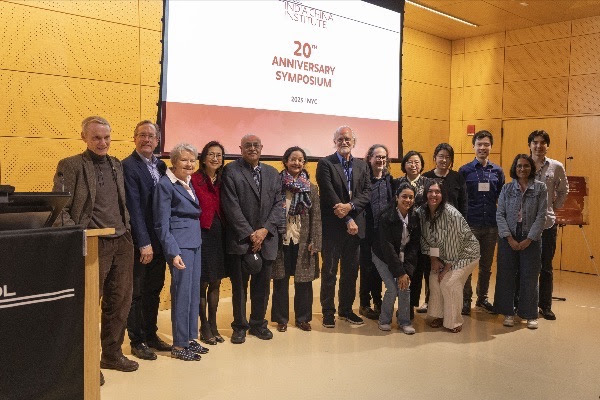
On April 24-25, the India China Institute marked its 20th anniversary with a series of four panels featuring presentations by leading scholars working on India, China, and the United States, at the New School’s University Center.
New School President Joel Towers opened the symposium with reflections on his participation in one of ICI’s early programs on urbanization and globalization, and his numerous informal discussions with scholars and practitioners from Chinese and Indian institutions on pressing issues of the time, especially climate change and urban futures. President Towers noted that ICI was founded just before the revolution in global communications prompted by the diffusion of smartphones and social media platforms. He remarked that the contemporary moment of upheaval was perhaps unsurprising in light of tectonic technological changes, challenges of climate change, and global inequity.

Opening Remarks by President Joel Towers of The New School


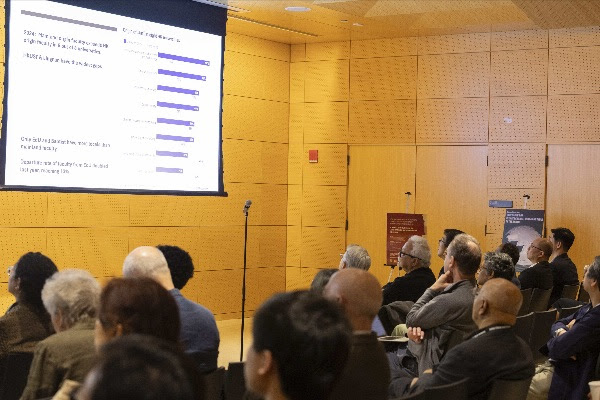
Left: Panel 1: The University Under a Global Authoritarian Turn
Right: Apoorvanand Jha shared his remarks virtually, sending a recorded speech in lieu of attending the Symposium in person.
The symposium’s first panel, The University Under a Global Authoritarian Turn, was moderated by Mark Frazier, Professor of Politics at the New School and a Co-Director of ICI. The presentation featured Craig Calhoun, University Professor of Social Sciences, Arizona State University; Apoorvanand Jha, Professor of Hindi, University of Delhi; and Kellee Tsai, Distinguished Professor, College of Social Sciences and Humanities, Northeastern University.
Professor Tsai introduced the Academic Freedom Index and changes in academic freedom over time, in India, China, Hong Kong, and the United States. Professor Jha, whose university had not granted his leave request to attend the symposium, spoke in a recorded presentation about his university’s actions and the concept of anticipatory obedience. He also discussed new state controls on education that have resulted in high levels of censorship and self-censorship in India. Professor Calhoun’s remarks included a discussion of academic freedom, its origins and purposes, and the notable marginalization of humanities and social sciences in all three countries even as American, Chinese, and Indian universities engage in competition for research funding in sciences and engineering as means to national and global prestige.

Panel 2: De-globalization and a New International Political Economy
The second day of the symposium opened with De-globalization and a New International Political Economy, moderated by Manjari Mahajan, Associate Professor, Julien J. Studley Graduate Programs in International Affairs, and a Co-Director of ICI. This panel included speakers Ravi Kanbur, T.H. Lee Professor of World Affairs, Cornell University; William Milberg, Professor of Economics, The New School for Social Research; and Min Ye, Professor of International Relations, Pardee School of Global Studies, Boston University.
Professor Ye compared India and China’s economic trajectories in the wake of hyper-globalization, noting some convergence despite distinct historical pathways and competition over regional dominance and global influence. In an introspective talk, Professor Kanbur dwelled on why the experts who had criticized Bretton Woods institutions were now, in apparent contradiction, arguing against tariffs. He concluded that the challenge of the coming decades will be less about tariffs and more focused on redistribution. Professor Milberg explored capital competing imports in the last decade and how this substitution produced a pressure on profit shares that shifted the relationship between the US and China to a trade war. He noted that deglobalization would eventually be unsustainable and discussed the desired contours of a new globalization.
Panel 3: Contesting History and Memory
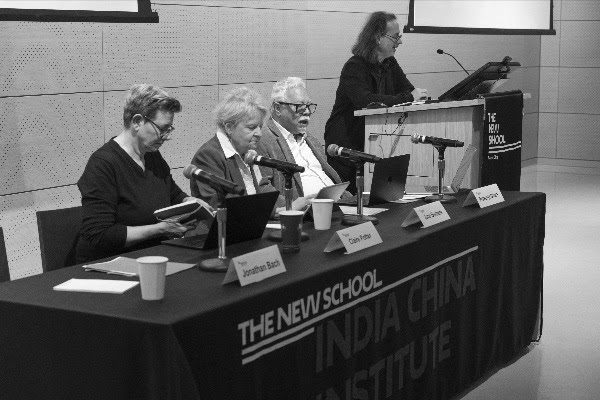
The panel Contesting History and Memory was moderated by Jonathan Bach, Professor of Global Studies at the New School. The presenters included Jane Burbank, Professor Emerita of History & Russian and Slavic Studies, New York University; Prasenjit Duara, Oscar L. Tang Chair of East Asian Studies, Duke University; and Claire Potter, Professor Emerita of History at The New School for Social Research.
Professor Duara argued that China is actualizing the role of civilization across much of the world using its Belt and Road Initiative (BRI). Professor Burbank presented how the history of Russia has always been one of contestation and is an illustrative tool in the vision to recover the empire. Professor Potter juxtaposed the wave of dismantling of Confederate monuments in the US with the Trump administration’s upcoming Garden of Heroes as a reconfiguration of memory in American exceptionalism and assimilation.

Panel 4: India and China in the Making of a Post-Liberal World
The final panel, India and China in the Making of a Post-Liberal World, included Professors Tsai, Ye, and Duara, along with Professor Peter J. Katzenstein, Professor of International Studies at Cornell University. Professor Katzenstein opened the panel with reflections on the concept of uncertainty, which the social sciences still grapple with even as natural sciences such as physics have long embraced it. Noting the profound disruptions to global order, Professor Katzenstein charted his vision of how a new international relations could be redefined by regionalism, great power spheres of influence, and other unpredictable configurations. In their responses, Professors Ye, Tsai, Duara, Mahajan, and Frazier noted that the decline in US power created possible openings for cooperation and greater agency among state and non-state actors, and perhaps even a new multilateralism that leaned on power distributed in a multipolar world.