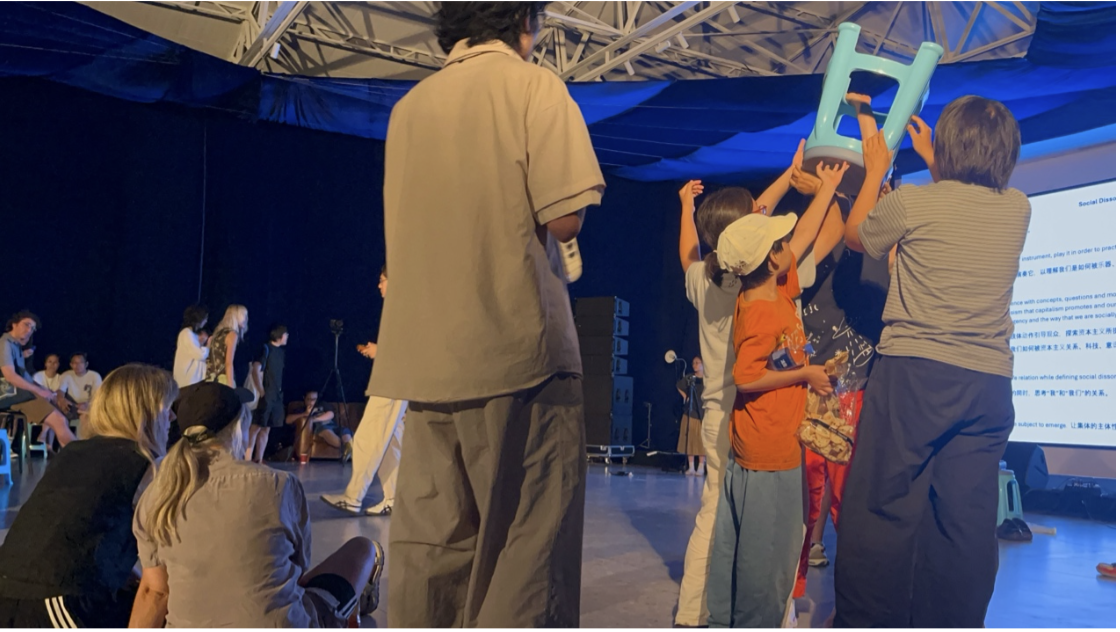
That summer, I went to an experimental music festival in Beijing. The organizers brought together artists from different countries and cultural backgrounds to perform in a temporarily rented space, each finding their own ways of expression and pushing against the boundaries of music and the instruments.
During the break, I stood outside talking with Y, a friend of one of the organizers. He told me that he was disappointed with art. He still thought the festival was excellent, but in the current world, art seemed almost powerless. AI was developing at an astonishing speed, he said, while the world around us seemed to be gradually falling apart. Before long, more and more people would be replaced by AI, and we should think about how to improve human life. A festival, by contrast, was a celebration. A way of living for the moment, live as if tomorrow did not matter. But it could not change the despair of the present. He said he disliked utopian narratives, as he considers it to be a form of escape, a posture taken when people had already failed in the current world, and could no longer find a way to live in it. A celebration was the same. Celebrating on the ruins was certainly poetic, but it could not stop the disaster from coming, nor could it create any kind of collective action.
He said that the festival itself was also a relatively bubble-like artistic space, created by people privileged enough not to be constantly preoccupied with making a living. But in the real world, we could pay just six yuan (less than one dollar) for food delivery, and have a delivery worker risk their life. He no longer wanted to enjoy these pleasures afforded by a structure of privilege while feeling guilty about it. The good days in which people could simply come together and play like this would not last much longer, he said. The end of the world was coming.
As we talked, people around us were kicking shuttlecocks and playing with water guns. Water splashed around us, and every now and then a shuttlecock flew our way, followed by someone coming over to take it and apologize. Some were operating a walkable synthesizer, playing plastic saxophone and flutes.
Inside the venue was a workshop claiming to resist capitalism. The organizer clearly knew little about China, projecting a romantic fantasy onto a country with a different social regime. The workshop itself also carried the feature of a thought experiment: full of assumptions detached from context. The problems we were facing were much more specific, and much more urgent. He said that we needed to reclaim freedom and liberation. Of course, he was not wrong. But simply removing limits and rules so that everyone could play was not enough to make that possible. The logic of capitalism produces desire and pleasure, but we also live in an environment that constantly suppresses them. Happiness has never been something that steadily accumulates for us. It exists at the margins, in small acts of resistance; it takes root in pain, in the cracks where we play with rules and provoke their boundaries.