
Hyderabad Hair Stories
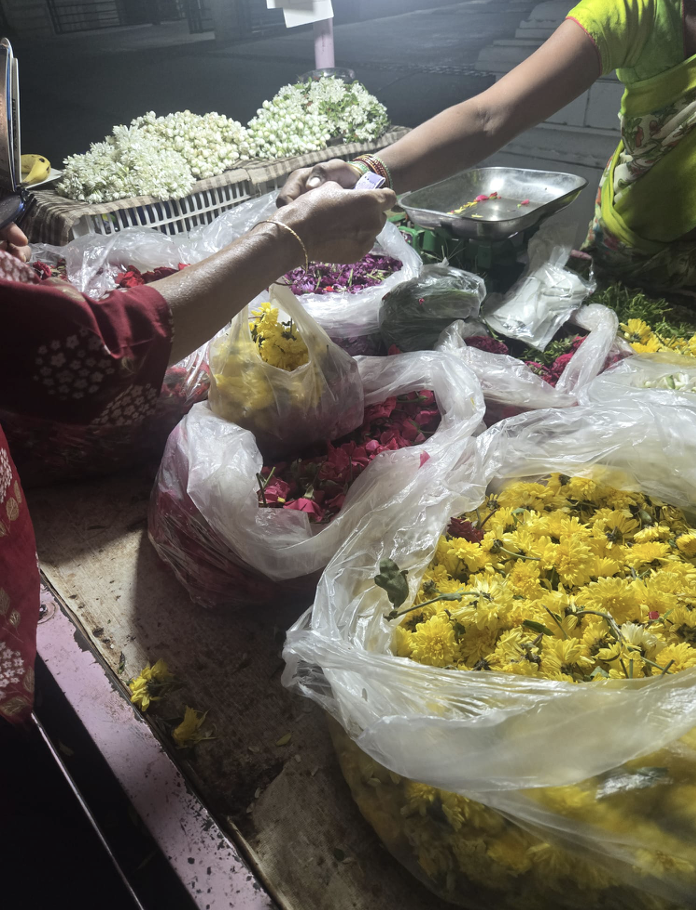
My aunt buying flowers and garlands from a flower vendor for pooja.
In Hyderabad, I am being hosted by relatives who are as excited to show me around as always, and even more excited to assist with my project. My maternal grandparents live just a five minute walk away. I go to visit them almost every day that I am here, accompanying them for their evening coffee. In this short walk, I receive an unusual amount of attention from people on the street. I overhear a young girl telling her mother to look up, quickly, at the girl with blue hair. Another group of friends exclaim that her hair matches her dress. Other people are just looking. My hair has faded blue streaks and I am wearing a similarly teal-blue kurti.
I wonder if my hair really is that much of a spectacle, though I have yet to see someone else with colored hair. My aunt suggests that I might blend in more once I get to Bangalore.
As my grandmother boils milk on the stove, her long braid is reflected onto the marble countertop. Her hair, which for my entire life has been a deep orange-red from years of henna dye, is now varying shades of gray. Pictures of her red hair are hugged by frames in each of her kids’ homes. She has given up applying henna to her hair, saying she wants to look “more her age.” My grandfather has also given up henna and his hairs have gone gray. He spends his days in front of the TV, watching Telugu soaps that I am unable to distinguish from one another. Most of the time, I look over and he is asleep. Ad breaks play in ten minute intervals, with repeated shampoo commercials. They are essentially the same: ecstatic girls shaking their long, thick, jet-black hair; narrator promises of strong and healthy hair; digitally-rendered clips of hair being stretched and manipulated to prove their strength.
Today’s show is entitled Intinti Ramayanam, which literally means “a Ramayana in every household,” though what it actually means is that every family contains drama that is vibrant and intense enough to rival an age old Indian epic. The antagonist, Pallavi, marked by a sinister soundtrack and dramatic monologues, has bleached brown hair that falls just past her shoulders, hanging loosely from her scalp rather than tied back. All of the other characters have the long black hair from the commercials, oiled back into braids or updos. I take this to imply their well-behavedness, as opposed to Pallavi’s wild defiance.
Afterwards, my aunt helps me arrange an interview with the founder of an NGO called Hyderabad Hair Donations. I understand and speak Telugu semi-fluently, my aunt chiming in with what she perceives to be gaps between my questions and his responses. When I am through with my questions, he looks at me, though it seems like he’s looking past me. He asks me to turn my head to the left, then right. I comply, mystified. He asks if I’ve noticed any problems with my health, or my hair. He asks whether my mother has ever had hair problems, and my aunt swiftly clarifies that my mother has thick, long, and beautiful hair. He suggests that the bleach I had used to create the blue streaks in my hair are contributing to early female pattern baldness. He recommends the following:
- Change the part in my hair, stop oiling it and braiding it so tightly. This is advice I’ve never been given. In fact, it is entirely contrary to the advice my mother, with the perfect hair, has given me my entire life. I even wore braids to meet him, hoping to look neat and put together.
- Check for iron and thyroid, some kind of deficiency. A good doctor will prescribe a medicine course to follow for one month.
- To salvage what’s left and prevent further loss, shave my head and start over. It will grow back thicker and curlier.
My aunt is asking follow up questions, eager to pick the brain of a professional, as I sit there silently and watch. I haven’t posed any questions about my own hair, but am quickly learning a lot about the time, effort, and scrutiny that a woman’s hair is worth.