
Bengaluru Hair Stories
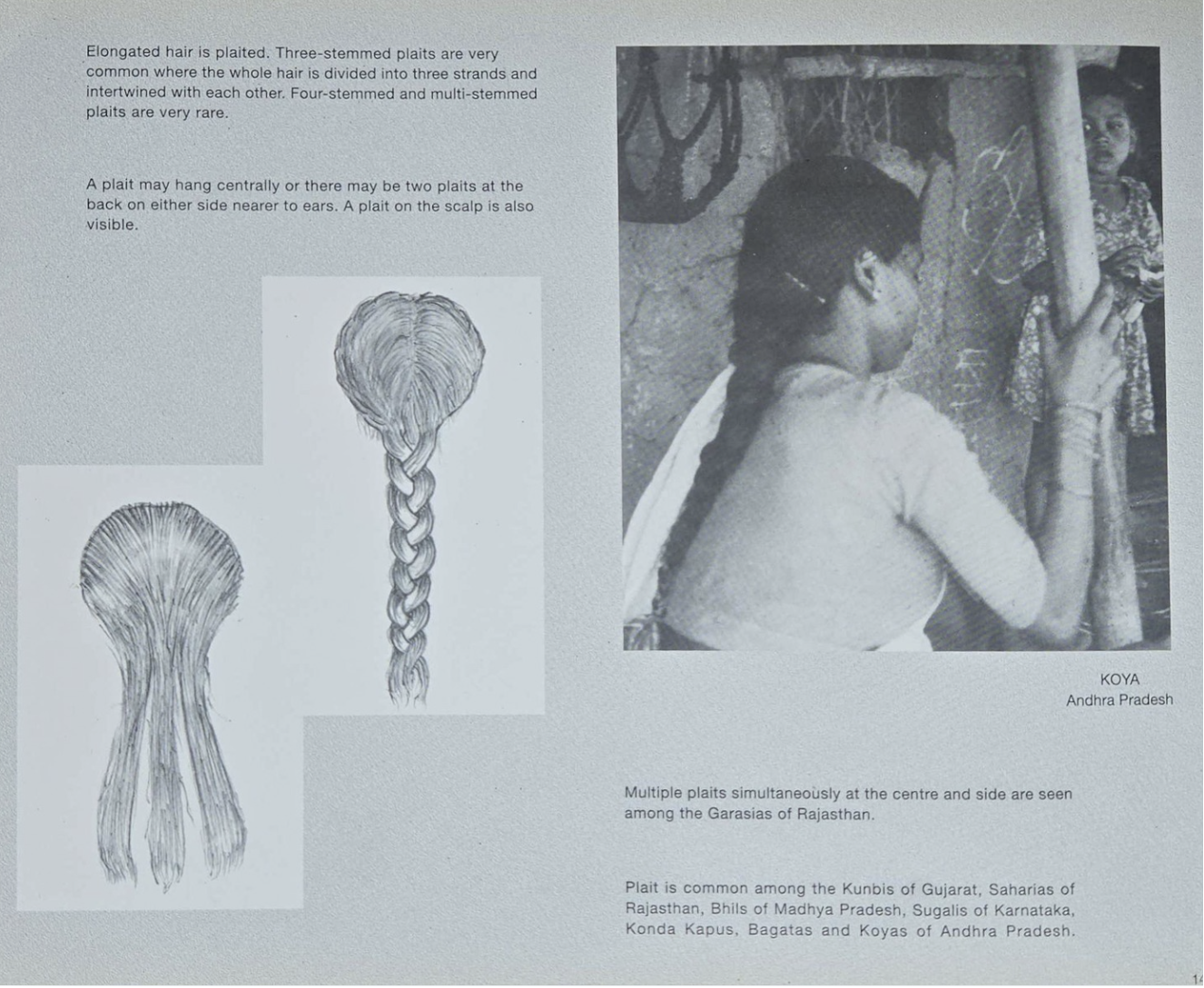
A scanned page from Bharati Debi’s “Hairstyle: Panorama of the Tribal World.”
My time in Bengaluru is spent with more relatives, in a home containing more books than space to keep them. I had personally ordered several rare and hard-to-find books to be delivered to their house so that I could minimize the amount of luggage I had to drag from Hyderabad to Bengaluru. My literature review led me to a rare book called “Dressing and Hairstyling in Ancient India,” where I found the following quote outlining the history of the middle part:
“In the various styles of dressing the feminine hair, there is one peculiarity worthy of special notice, it is the want of the parting of the hair along the mesian line from the forehead backwards. This parting is regarded by modern Hindu women as a special mark of married life, and no…lady who has her husband living, will, on any account, allow this to be disturbed. Constantly parting the hair at one particular spot, and tying the locks of the two sides tight away, often lead to baldness along the middle line; but the dread of widowhood is too strong to override the custom” (68).
A hairstylist and wig maker that I had met in Hyderabad told me the same thing: the overworked middle part separating my tightly wound braids was causing premature baldness. What I didn’t know was that this method of parting the hair down the center of the head was a custom associated with married women, mainly because I had been doing it my whole life. Regardless of how removed any of us are from the origins of this practice, it is still extremely common and relevant to how women style their hair today.
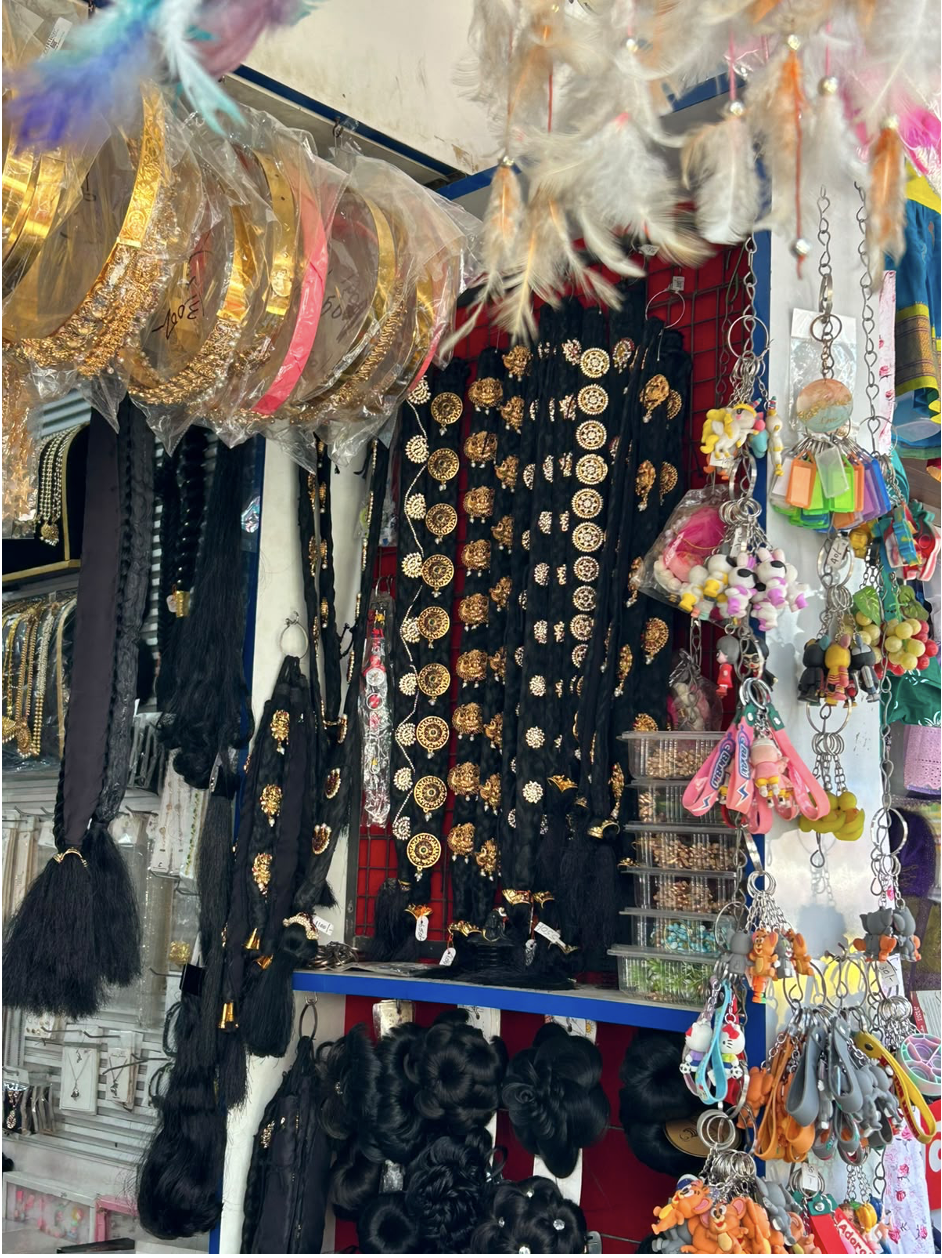
A street stall in 8th Cross selling savarams, or false hair pieces.
Whilst in Bengaluru, I went shopping around 8th Cross, where the streets were lined with women actively sewing flower garlands, which are sold for ceremonial and styling purposes. I accompanied my aunts more than once to purchase these garlands, both here and in Hyderabad. Several of the shops contained savaram hair extensions, or false hair pieces used to add length and volume to one’s natural hair, typically for ceremonial purposes. These pieces being sold in street stalls were most likely made with partly synthetic material, though one would be able to find natural hair pieces in wig shops or salons.
My aunt helped me set up an interview with Bengaluru waste management activist, Vani Murthy, who had recently posted content about her experience collecting her own hair and the greater industry of hair picking. I was excited to meet her and even more excited that she happened to be their upstairs neighbor. In our interview, we discussed the door-to-door hair picking industry, how cultural practices dictate what women do with their fallen hair, and the greater waste management industry. I learned that Vani played a major role in implementing waste management efforts within their own building; she and her co-activists would call themselves “The Glamorous Garbage Girls” in an effort to both romanticize waste management and destigmatize handling one’s own waste. In the early days of this program integration, my cousins and other children living in the building would help show people how waste works.
I also visited the Mythic Society Library, toured personally by Project Director, Udaya Kumar P.L., who is a personal friend of my uncle. One of the main projects conducted at this library is the physical and digital conservation of ancient stone inscriptions in Bengaluru. The library also conserves and digitizes palm leaf manuscripts. Within their repository of 46,000 rare books, approximately 24,000 are in English. Several of these books proved useful in researching historical records of hair ceremonies and practices, and I was able to make scans of many of them.
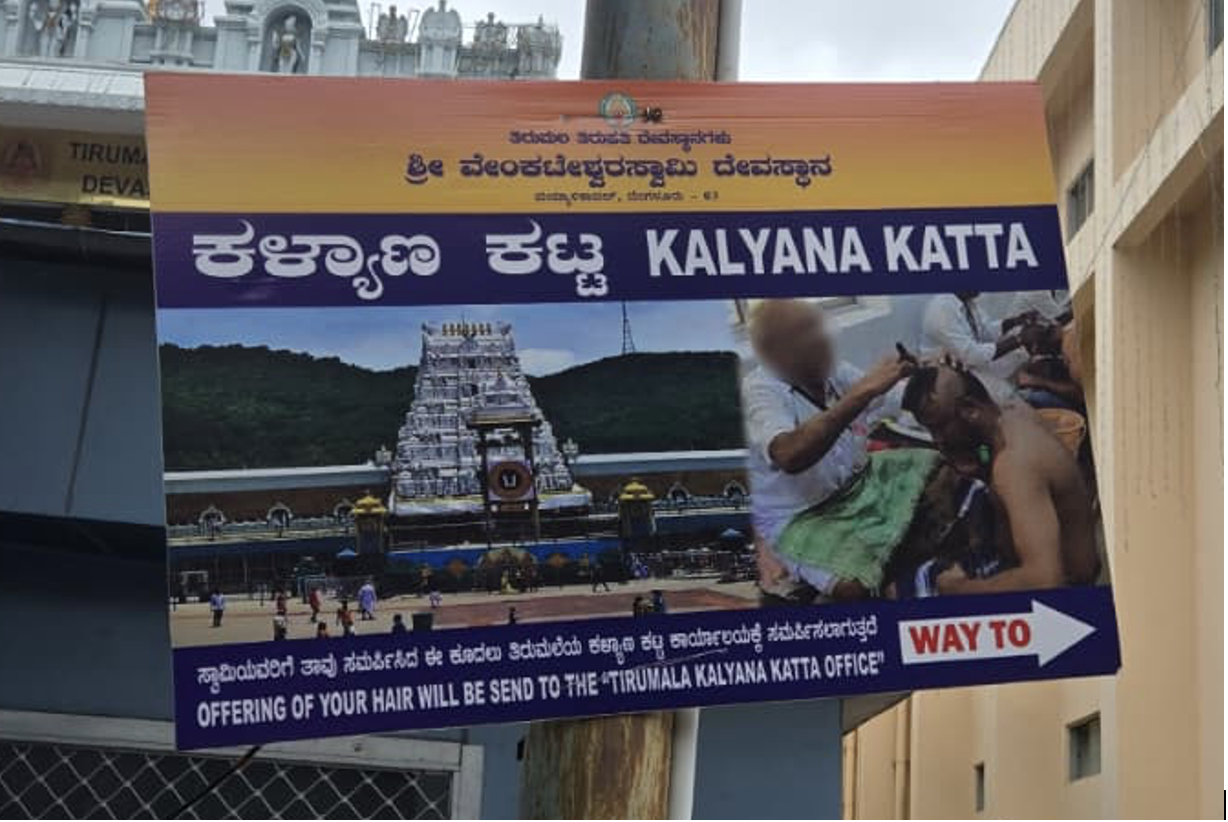
A sign leading to the tonsurer’s office outside of the TTD temple.
On my final afternoon before I would return to New York, my aunt and I were able to secure an interview with a hair tonsurer at a local temple. In our initial request for an interview, the tonsurer was under the impression that I was looking to have my own hair tonsured that day. We were quick to clarify that we had just come to speak with him about his work, but I couldn’t help but wonder if this was my opportunity to begin my hair regrowth journey. After all, the hair removed in this process would go on to be used in wigs or hair extensions, and I had already been recommended to shave my head by the hair professionals that I had interviewed in Hyderabad. In the end, I left Bengaluru with the hair on my head still intact, but this interview marked the successful completion of both my field research and my 2026 summer trip in India.